


Data center and UPS – critical infrastructure for stable operation
Server rooms, data center solutions and UPS solutions are the foundation for stable and secure digital operations.
At KM Telecom, we provide data center infrastructure for projects where uptime, security and documented functionality are crucial.
We are involved in both smaller and complex data center installations, where data center and emergency power infrastructure form a critical part of the overall IT and building installation, and where there is no room for error.
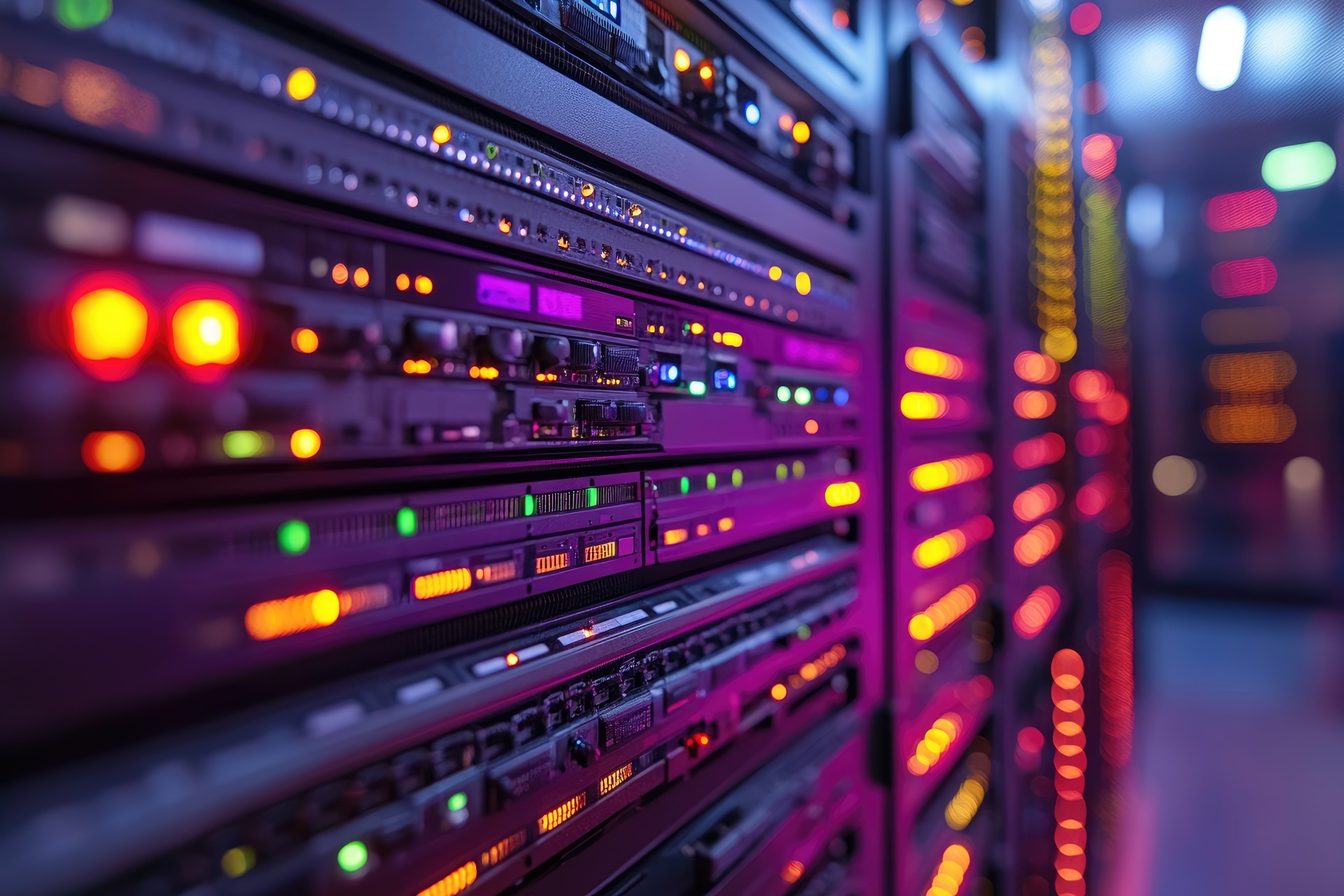
Data center and UPS capabilities
We deliver well-crafted data center solutions and handles all central disciplines as an integrated part of the project:
- Analysis and planning of server rooms and data center environments
- Data center design of data center and server room infrastructure
- UPS installation and UPS design, including sizing and integration
- Battery solutions, testing and replacement
- Redundant power supply and network infrastructure related to server environments
- UPS monitoring, documentation and service
- PDU data center solutions as well as expansions and upgrades of existing installations
We work with recognized and proven solutions and select components based on requirements for operational reliability, load and lifespan – not standard configurations.
Precision, quality and responsibility – all the way
We take responsibility for the entire data center solution and UPS delivery and works structured from data center design for commissioning.
In practice, we often act as a specialist partner for the electrical installer, where we independently handle data center installation and the emergency power part as a critical part of the project.
We deliver the solution complete, tested and documented, so it can be transferred directly into operation - without any extra work for you.
The result is a stable and robust data center infrastructure w/ redundant power supply, which protects critical systems and ensures continuous operation – even during power outages or load peaks.
Would you like help finding the best solution for your business?
Contact us for a no-obligation meeting.


Frequently asked questions about data centers and server rooms (FAQ)
What does KM Telecom do in a data center or server room?
We take on the entire contract: analysis and planning of the space, design of the infrastructure, redundant power supply, UPS with dimensioning and installation, battery solutions, PDUs, the network infrastructure in the racks, as well as monitoring, documentation and service. Work that requires authorization, for example on the cooling system, is carried out by our subcontractors with us as responsible for the delivery. You have one agreement and one contact all the way.
How do you plan a new server room?
We start with the need, not the drawing: how much power the room needs to handle, how many racks, what redundancy is required, and how much room there needs to be for growth. From there, we lay out the rack plan, routing, power distribution, and cooling so that the parts fit together. It is far cheaper to allocate space for the next rack now than to build the room two years later.
Who does the cooling?
The cooling is included in the contract. The actual work on the cooling system requires authorization and is carried out by our subcontractor, while we are responsible for the coordination and delivery as a whole. We include the heat load from the racks and UPS in the dimensioning, so that the cooling system matches what the room actually emits, and not a loose estimate.
What is redundant power supply in practice?
Two independent supply paths, an A-side and a B-side, run physically separate all the way to each rack. Equipment with two power supplies is connected to a PDU on each side, so that a single failed link, a panel or a UPS, does not take down the operation. Redundancy is only real if the two paths do not meet along the way, and that is exactly what the documentation must be able to show.
What is a PDU and which type should we choose?
A PDU is the power strip in the rack that equipment plugs into. There are three levels:
- Basic: distributes electricity without metering. Cheapest, and probably where consumption is known and stable.
- Metering: shows usage per rack or per outlet, so you can see the load before it becomes a problem.
- Managed: can also turn the individual outlet on and off over the network, which is useful when no one is in the house.
We recommend measuring per rack as a minimum. This is the basis for sizing the UPS correctly next time.
What is the purpose of a UPS system?
A UPS keeps power running when the utility fails or dips. It takes over without interruption and continues to run on battery power until the utility is restored or an emergency generator is started. At the same time, it cleans the power from spikes and fluctuations from the power grid, which over time wear out server equipment and network components.
Which UPS topology is suitable for critical IT?
The type that is called online double conversion or VFI in the data sheets. The system continuously converts the current from the power grid to direct current and back again, so that the equipment always gets a clean, newly generated voltage, regardless of what happens in the grid. In the event of a power failure, the switching time is 0 ms, and the operation does not notice anything. This provides complete decoupling from the voltage fluctuations of the power grid, and therefore it is the topology that we recommend for server rooms and data centers.
How are capacity and battery life calculated?
We calculate the total power requirement for all connected equipment (kW and kVA) and add an allowance for future growth. The battery bank is then sized based on how long the operation needs to run: minutes enough for a controlled shutdown, or longer if there is no generator. We recommend measuring the actual consumption rather than calculating from the equipment's nameplates, which almost always indicate more than is used.
Lead-acid or lithium-ion batteries?
- VRLA (lead-acid): lower purchase price, but shorter lifespan of typically 3 to 5 years, greater weight and more floor space.
- Lithium-ion: longer lifespan of typically 10 to 15 years, less space and weight, and better tolerance to high room temperatures.
Lithium costs more to buy, but is often cheaper over the entire life of the system because the batteries need to be replaced fewer times.
How is the UPS system monitored and serviced?
The system is monitored so that load, battery condition and errors can be followed, and alarms are raised before the operation notices anything. In addition, there is planned service with testing of the battery bank, because a battery that has been untouched for four years does not necessarily last as long as it is designed for. You receive documentation of measurements, tests and replacements, so you can always see when the batteries were last checked.
Can you expand or upgrade an existing facility?
Yes, and that's a big part of what we do. A system that is sized for yesterday's consumption can be expanded with more UPS modules, a new battery bank or more PDUs without having to rebuild the room. We always start by measuring the actual load, because it is almost always different from the drawing, and then add the expansion on top of what works.
About us
KM Telecom is a family-owned company with over 20 years of expertise in data networks, mobile coverage and telecom solutions for businesses – always with the customer's needs and long-term solutions at the center.
This is how we think
We make the complex simple. Our approach is technically strong, solution-oriented and founded on a desire to deliver a stable and future-proof infrastructure – every time.
Company culture
We believe in old virtues in a modern industry: working hard, keeping promises, and being trustworthy. Our culture is built on professional pride, collaboration, and respect – both internally and towards our customers.