


Customer count, see who uses the house, when and where
A counter above the entrance, and you have a count of how many people use the house. Not an estimate, but the number of people, hour by hour, day by day and season by season.
The setup requires no cables or access to your network. The counters register that someone is passing, not who.
The numbers are combined with bookings, consumption and weather. This way you can see whether the booked hours are being used, what needs to be staffed when, and whether what you initiated worked.
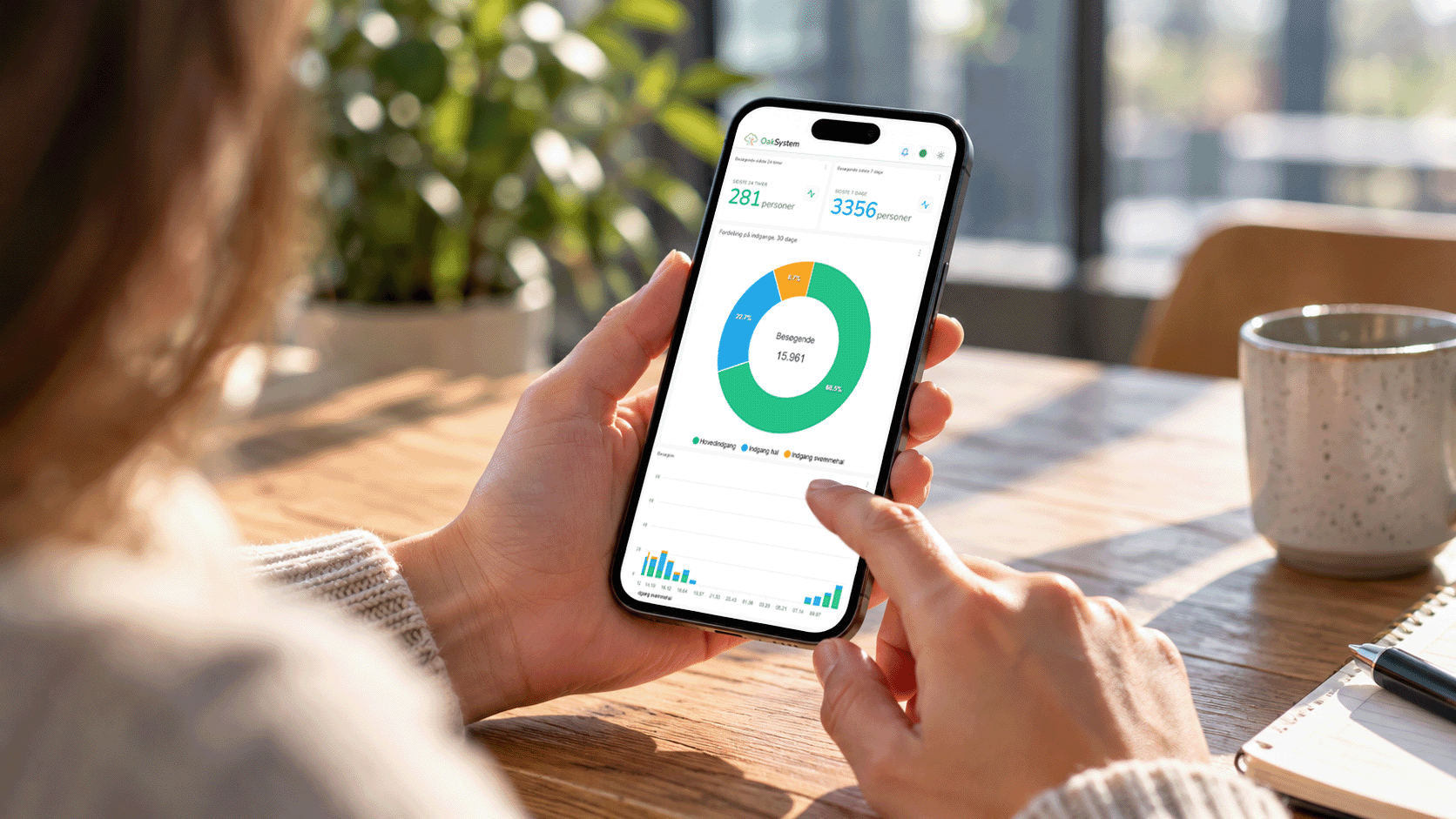
From counting to decision
Measure whether an initiative worked – An event, a new opening hour, a new team or a campaign can be measured by the number of people before, during and after. Then you can see if it attracted anyone and if they came back the following weeks. The method is the same regardless of whether the initiative is large or small, and it makes it possible to repeat what worked instead of what felt right.
Set staffing and opening hours according to when people arrive. – With numbers for each hour, it becomes visible when the house is full and when it is empty. Staffing, cleaning and opening hours can then be planned accordingly, and it can be decided whether a quiet opening hour is worth keeping open, or whether the hour should be moved to where there is demand.
Keep the number of visitors up to the weather – The number of visitors to a swimming pool and outdoor facilities closely follows the weather. With a local weather station on the premises, temperature, rain and sunshine are listed alongside the counting figures. Then a quiet week can be explained by the weather instead of being taken as a drop in interest, staffing can be set according to the outlook the day before, and the effect of a new initiative can be assessed without the weather taking credit or blame for it.
Document usage to those who ask – The municipality, board, grant-givers and associations ask the same question: how much is the house actually used. The figures can be drawn for a selected period, and because they are measured and not estimated, each figure can be traced back to a counter and a point in time.
With customer counting you can:
- See number of people per entrance, zone and time
- Compare occupancy with booking, so it becomes visible how much the booked hours are used
- Measure the effect of an event or initiative on the numbers before, during and after
- Keep visitor numbers in line with the weather so that a quiet period can be explained and staffing can be arranged according to the weather.
- Prioritize cleaning where there has been the most traffic.
- Adjust heating, lighting and ventilation according to actual use
- Document the use of the house for a selected period
Three types of counters are used, and the choice depends on whether counting is to be done in a narrow doorway or in a wide, open area. 3D sensors measure distance with light pulses and count accurately regardless of lighting conditions, even in the dark. Thermal counters detect heat signatures that cross an invisible line. Camera-based counters have a lens, but the image is processed in the sensor itself and is never stored. What all three have in common is that no images are stored.
Counting is not monitoring
Children and young people come into the house every day, so the question of privacy is closer here than in an office building. The answer is that the counter cannot see who is passing by.
- No faces, no personal ID and no biometric data are recorded
- No images or video are stored, not even on the camera-based counters, where the image is processed in the sensor itself and never leaves it.
- What is passed on is a number: how many passed a point and when
- The counter cannot recognize the individual and cannot follow anyone around the house.
Consideration for personal data is built into the structure of the solution, and we agree on the specific setup with you before anything is installed. We also recommend that you openly tell associations, members and staff about it, and that it is clear with signage where the counting is done. Acceptance means more than technique here, and numbers that some people are insecure about are not used for very long. If the building is municipal, the municipality may have its own guidelines, and we include them in the setup.
It pays off in three places
Economy – Staffing, opening hours and cleaning can be set according to actual load instead of a schedule. The quiet hours become visible, and then it can be decided whether they should be staffed, used for something else or closed.
Drift – The load can be seen hour by hour, so that cleaning and replenishment can be done where there has been the most use, and heating, lighting and ventilation can follow the actual use.
Documentation – Visitor numbers for a selected period can be reported to the municipality, board and grantors. Because the numbers are measured and not estimated, each number can be traced back to a counter and a time. This is also the basis for assessing whether an event or new opening hours attracted anyone.
Would you like to hear how it fits your house?
Contact us for a no-obligation meeting.


Frequently Asked Questions about Customer Counting (FAQ)
How are visitors counted and is it anonymous?
With counters at entrances and in selected zones. They register that someone passes, not who. Neither faces, personal ID, biometric data nor images are stored, not even on the camera-based counters, where the image is processed in the sensor itself. What is sent forward is a number and a time. The specific setup is always agreed with you before anything is installed.
Can we see if the booked hours are actually used?
Yes, if the booking system can provide data via API. Then what is booked can be compared to what is measured, and the difference becomes visible: hours that are not used, teams that leave earlier, and periods where there is more activity than reserved. This is often the first thing the numbers reveal, and it is the difference that matters when the hours are to be distributed.
Can we measure whether an event or a new initiative worked?
Yes. The number of people can be calculated before, during and after, and the development can be followed in the weeks that follow. If the number is also compared to the weather, a quiet period can be explained instead of being taken as a drop in interest, and an initiative can be assessed without the weather taking credit or blame for the result.
Can we be notified when consumption is abnormal?
Yes, but it depends on where the number comes from. Measurements from the energy hub are typically one to two days delayed, so they are good for finding patterns, but not for intervening. The secondary meters on LoRaWAN measure immediately, and you can react while it is happening. For each meter, a normal level and a limit value are entered, and if it is exceeded, a message is sent by SMS, or it can be viewed in OakSystem.
About us
KM Telecom is a family-owned company with over 20 years of expertise in data networks, mobile coverage and telecom solutions for businesses – always with the customer's needs and long-term solutions at the center.
This is how we think
We make the complex simple. Our approach is technically strong, solution-oriented and founded on a desire to deliver a stable and future-proof infrastructure – every time.
Company culture
We believe in old virtues in a modern industry: working hard, keeping promises, and being trustworthy. Our culture is built on professional pride, collaboration, and respect – both internally and towards our customers.