


Temperature, CO2, noise, humidity and weather
The five measurements are rarely the ones you start with. However, they are the ones that tell how the house is experienced while it is being used.
Temperature and CO2 are about the customer experience. If the hall is too hot or the air in the room is heavy, people will remember it, no matter how good the event was. Noise is about the same thing, that is, that the sound level stays where it should be, so that the guests have a good experience, and so that the activities do not bother each other. Humidity is about the building: it tells you when something is wrong with a technical installation, long before it becomes water damage. And the weather station provides something that none of the others can, namely an explanation. How much of the visitor number is due to your efforts, and how much is due to the fact that it rained all week?
Five measurements, one image, along with consumption and visitor numbers.
“With wireless sensors, conditions are turned into numbers. CO2, temperature and humidity are measured in the halls and rooms where people are.”
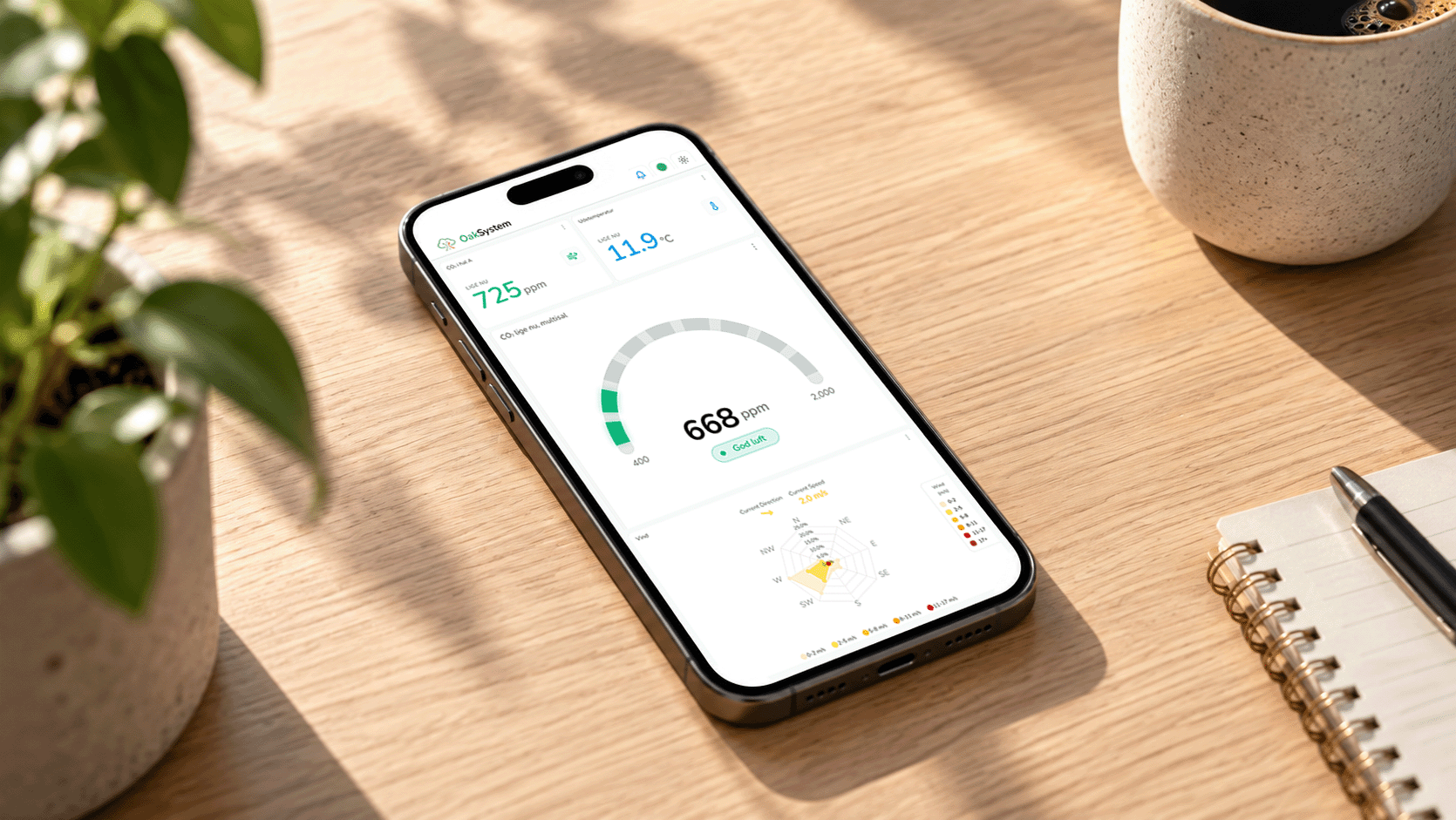
From measurement to action
The temperature is felt first – Temperature is what users notice before anything else. Too cold in the changing room after a match, too hot in the hall for a meeting, or a room that never gets warm enough in the morning. It's rarely something that someone reports as a fault, but it's something they remember and talk about. With measurements in the rooms concerned, the conditions can be seen hour by hour: how cold it actually was, how long it was on, and whether it's related to when people were in the room. Then the heat can be adjusted where it needs to be adjusted, instead of being turned up throughout the house because someone has complained in one place.
The air where people are – CO2 is the best single measurement in a room with people because it rises when more people enter and falls again when air is removed. Above 1.000 ppm, people start to get tired and unfocused. Together with temperature and humidity, it gives an idea of whether the room is functioning and a response to the person complaining.
A basis for adjusting ventilation – CO2 increases when more people enter the hall, and decreases when it is ventilated. The measurement therefore shows when the air is good enough and when it is not. The first thing it provides is a better experience for those who use the building: you can see whether the air is actually holding up when it is full for a convention, instead of being told afterwards. The second is a basis for adjusting the operation. If the system is running too little during the hours when the hall is full, it can be seen. If it is running too much during the hours when it is empty, it can also be seen, and there is usually money involved. If the supplier of the CTS system can open access, we also retrieve the system's own operating data, so that the measurement in the hall and the system's settings can be seen next to each other.
Moisture before it becomes an injury – Moisture sensors are installed in technical rooms, basements, pool rooms, depots and under installations where a break is not immediately detected. If the moisture increases or water appears where there should be no water, a message is sent. It is the cheapest measurement on the entire list, measured in terms of what overlooked damage costs.
Noise, measured instead of discussed – A noise sensor measures the sound level continuously, for example in the hall, in the fitness area or in the café. This provides a basis for assessing the conditions for both staff and users, and for seeing whether the level changes when an area is redecorated or has new activities. The value is the same as for the indoor climate: the conditions can be documented over a period of time instead of depending on who asks when.
Weather as explanation and as control A weather station on the house shows temperature, rain, sun and wind locally. This provides two things: outdoor systems, heating and ventilation can be controlled according to the actual conditions, and a quiet week or high consumption can be held up to the weather instead of remaining unexplained.
With indoor climate, humidity and weather you can:
- Monitor CO2, temperature and humidity in halls, changing rooms, meeting rooms and offices
- Measure humidity in technical rooms, wet rooms and pool rooms and get notified before anything happens.
- Monitor the noise level in the hall, fitness area or café
- See if the ventilation is on when the hall is full and if it is running when it is empty
- Keeping the indoor climate up to date with visitor numbers, consumption and weather in the same picture
- Show the air in the room to users with a smiley on the sensor, a QR code or a screen in the common area
- Document the conditions over a period of time if anyone asks about them
The sensors are wireless and battery-powered, with a typical battery life of 5 to 10 years. They can therefore be installed in an existing building without running cables, and they can be moved if the house changes.
It pays off in three places
Economy – Heating and ventilation are among the heaviest items in the house, and they typically run according to a schedule and not according to how many people are in the house. The measurements show where heating and ventilation is used for no reason, and they document the effect of a change, so you can see if it worked. The moisture measurements are part of the same calculation: damage that is discovered early costs a fraction of one that is discovered when it is on the floor.
The customer experience – Temperature, air and noise are what users remember from a visit, and they are rarely something they report as a fault. With measurements in the rooms concerned, conditions can be corrected before they become a complaint, and a complaint can be verified instead of depending on who asked when.
Drift – The conditions can be documented over a period of time, and they can be viewed together with visitor numbers and consumption. This makes it possible to answer why the air was heavy at the convention, whether the ventilation was up to par, and what needs to be adjusted for next time. The weather station is part of this: it explains why a week looked the way it did, so that a quiet visitor number or high consumption can be held up against the rain and cold instead of standing alone.
Would you like to hear how it fits your house?
Contact us for a no-obligation meeting.


Frequently asked questions about indoor climate, humidity and weather (FAQ)
What conditions are measured?
CO2, temperature, humidity and noise in halls, changing rooms, meeting rooms and offices. Humidity in technical rooms, wet rooms, pool rooms and depots, where a leak can be expensive if left undetected. And the local weather with a weather station on the building. All three are displayed together with consumption and visitor numbers, so they can be read in conjunction with the rest of the operation.
Can we see if the ventilation is included?
Yes, and that is typically what the measurement is used for. A system with CTS is set up for the task and usually copes with it. A CO2 sensor in the hall is a simple and independent check to see if this also happens in practice: if CO2 rises and stays up while the hall is full, the system does not follow right then and there. If the level stays down, the settings are correct, and you know that too. Whether the air change can be controlled directly after the measurement depends on the system.
What if we don't have a building management system?
So we measure anyway. Many halls have ventilation that is controlled by a clock or a switch, and there is no system to retrieve data from. The CO2 sensor in the hall is independent of the system and shows what the air actually is like hour by hour. This is the basis for adjusting the times, for determining whether the system is sufficient for the use the hall has today, and for assessing when a replacement would be worthwhile.
What should we use weather data for?
Two things. Outdoor facilities and heating can follow actual conditions rather than the calendar. And visitor numbers and consumption can be kept up to date with the weather, which is especially important in a swimming pool and outdoor facilities, where visitor numbers closely follow the weather. Without weather data, it is difficult to tell the difference between an initiative that worked and a period of good or bad weather.
About us
KM Telecom is a family-owned company with over 20 years of expertise in data networks, mobile coverage and telecom solutions for businesses – always with the customer's needs and long-term solutions at the center.
This is how we think
We make the complex simple. Our approach is technically strong, solution-oriented and founded on a desire to deliver a stable and future-proof infrastructure – every time.
Company culture
We believe in old virtues in a modern industry: working hard, keeping promises, and being trustworthy. Our culture is built on professional pride, collaboration, and respect – both internally and towards our customers.